
Co-op basics
Nexon sells co-op as syncing with teammates to turn a fight. In practice that means timing combos, not stacking damage: hold your burst until a teammate's control lands, and keep one person free to revive.
Nexon sells co-op with one sentence: you work in sync with comrades to turn the tide of battle. The phrase is marketing for a mechanical idea, and the mechanical idea is worth unpacking before launch because it changes what you practise in the first hour. This page covers the party behaviour that the game's own description assumes.
The sentence, read closely
Nexon's listing says the combat has "the essence of diverse cooperative action where you work in sync with comrades to turn the tide of battle". Two words carry the weight: in sync and turn. In sync implies timing rather than proximity. Turn implies that group play is about reversing a losing state, not about stacking damage on a winning one.
| Phrase | What it rules out | What it points at |
|---|---|---|
| In sync | Four players doing their own rotation in the same room | Combos that connect across characters |
| Turn the tide | Pure damage stacking | Control, rescue and timing windows |
| Diverse cooperative action | One correct party shape | Different classes covering different jobs |
Nexon does not describe the combo system in detail. Inven's report, summarised by MobileNApps, adds two free tools that support it: Smart Party and Schedule Mode, both described as free for all players. Free logistics tools usually mean the designers expect pickup groups.
The four jobs in any party
| Job | What it does | What it costs to skip |
|---|---|---|
| Initiator | Starts the fight, takes the first hit | Someone else eats an unplanned opener |
| Follower | Adds damage inside the opener window | Damage lands outside the multiplier |
| Saver | Revives, cleanses, resets the fight | One death becomes a wipe |
| Caller | Names the target and the retreat | Four players solving different problems |
The caller is not a role you will find on a class menu. It is the person who says "left add first" and "we are leaving".
How to practise co-op in hour one
- Play the first hour solo anyway. You cannot time a combo with another player before you can time one with yourself.
- Learn one opener and one escape. Two buttons, both reliable, beat a full rotation you drop under pressure.
- In your first group, ask who is calling targets. If nobody answers, take it; a bad call beats no call.
- Hold your largest skill until the initiator's control lands. This single habit is most of what "in sync" means in practice.
- Keep one party slot's worth of revive consumables on you, not in storage.
- After each wipe, name one thing that went wrong. Groups that debrief improve; groups that re-pull do not.
Aggro, in a game without published numbers
Nexon has not published threat rules. What is safe to say is that a gear-driven MMO with bosses described as having deadly abilities will use threat, and that the practical behaviours are stable across the genre:
| Situation | Behaviour that works | Behaviour that wipes |
|---|---|---|
| Boss fixates on a damage dealer | Stop damage, move toward the anchor | Run away from the group |
| Add appears behind the party | Flex picks it up immediately | Everyone turns and burns it |
| Anchor drops | Second-toughest steps forward | Everyone scatters |
| Two players go down | Saver revives the anchor first | Revive the nearest body |
Those four rows are the whole of aggro management at launch fidelity. Numbers come later.
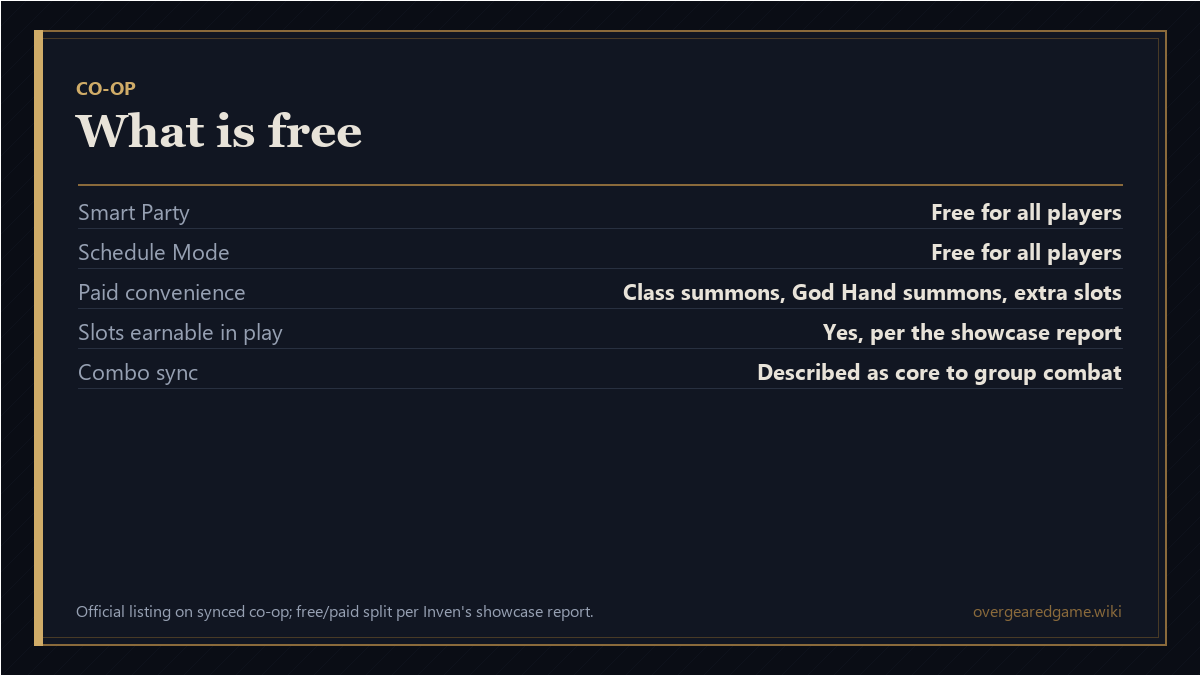
Free and paid split from Inven's broadcast report; Nexon's listing confirms synced co-op without itemising it.
Combos across classes
If the four reported lines are Staff, Greatsword, Bow and Bible, then the useful co-op question is not "who does most damage" but "whose window does mine open".
| Your line | You want a partner who | Because |
|---|---|---|
| Greatsword | Holds a target in place | Your damage is committed per swing |
| Bow | Pulls aggro off you when a boss turns | You need distance to keep firing |
| Staff | Groups enemies | Area damage needs density |
| Bible | Uses your buff window to reset the group | Utility scales with the party's timing |
That table is inference from weapon names and Nexon's "in sync" line. It is the first thing to correct once real play is visible, and the correct version will be measured rather than argued.
The bill for group play
Nothing, if you stay inside the free tools. Inven's report lists class summons, God Hand summons and extra progression slots as paid items that can also be earned through play, and states that most convenience features will not be sold. That leaves the real costs as consumables and time:
- Revive items, which a saver burns fastest
- Repair bills after a boss attempt
- Travel costs if your party forms across Dimensions
- The opportunity cost of a night spent learning instead of farming
The dimensions page covers the last one, because cross-server parties pay travel too.
Gaps in the record
Party sizes, threat formulas, whether combos extend across classes mechanically, and whether Smart Party exists in every region's build. Treat each as unmeasured rather than free.
Related: Human-Demon War is the mode where these behaviours matter most, and Vampire City is where they are tested hardest.